Understand what is happening – and act precisely.
The symptoms of organisational problems
are clear to see,
but what are the causes?
We uncover the invisible patterns in your company and analyse them formally.
To create more options for action.
How we proceed
We analyse communication and adaptive cycles to determine the current system state and the shortest path to the most functional target state of your team or company. Then we design precise measures to help you reach this goal without wasting resources through trial and error.
We do not offer just another toolbox of methods. Instead, we take a step back and use a precise framework for analysis, design, and implementation — tailored to your situation, strategy, and the people involved.
Our work is based on the following foundations:
- FORMwelt – formal analysis of communication patterns in social systems
- Model of adaptive system cycles – identification of key phases of system change
Seeing patterns more precisely than the naked eye
First foundation: FORMwelt
Real constructivism
At their deepest layer, social systems follow universal principles that can be described using a four-valued mathematical logic. There are six formal building blocks that develop their rhythm over time thereby generating an organisation's communication activity.
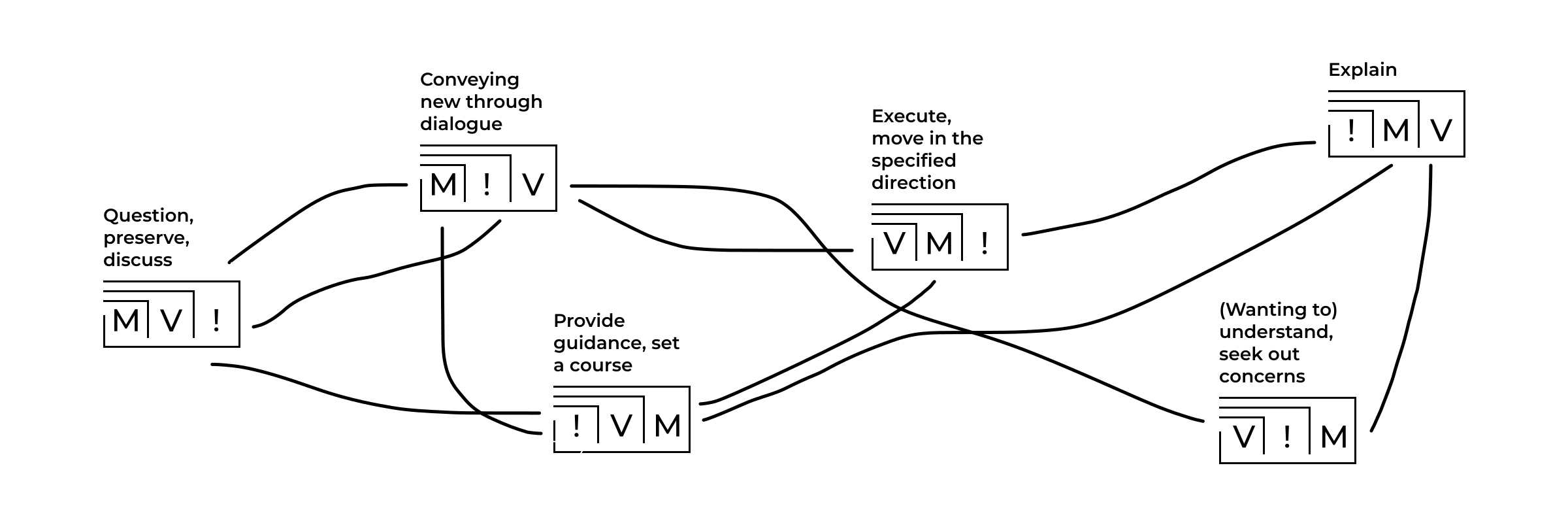
These rhythmisations produce 64 distinguishable system states, which can be clustered into four types:
Co-creative systems

Undirected creativity

Directed creativity

Monotone systems

None of these types is inherently good or bad. What matters is whether the current state of the communication system fits the organisation´s objectives.
FORMwelt's emulation tool uses computation to map the current state, the target state, and the necessary intermediate steps. This makes it possible to formally describe the delta between the current and desired state and to find the shortest, most efficient path to get there — it´s a matter of identifying which building blocks must be added, removed, or replaced.
C2M – Complexity Management Model
The Complexity Management Model (C2M) provides a framework to assess how individuals, teams, and the organisation as a whole handle varying complexity levels — and how these capabilities can be deliberately developed.
FORMwelt is the result of mathematical, cybernetic, and theory of systems research by Gitta and Ralf Peyn since the late 1980s.
Recognising cycles in development
Second foundation: the model of adaptive system cycles
Over time, organisations move through recurring phases:
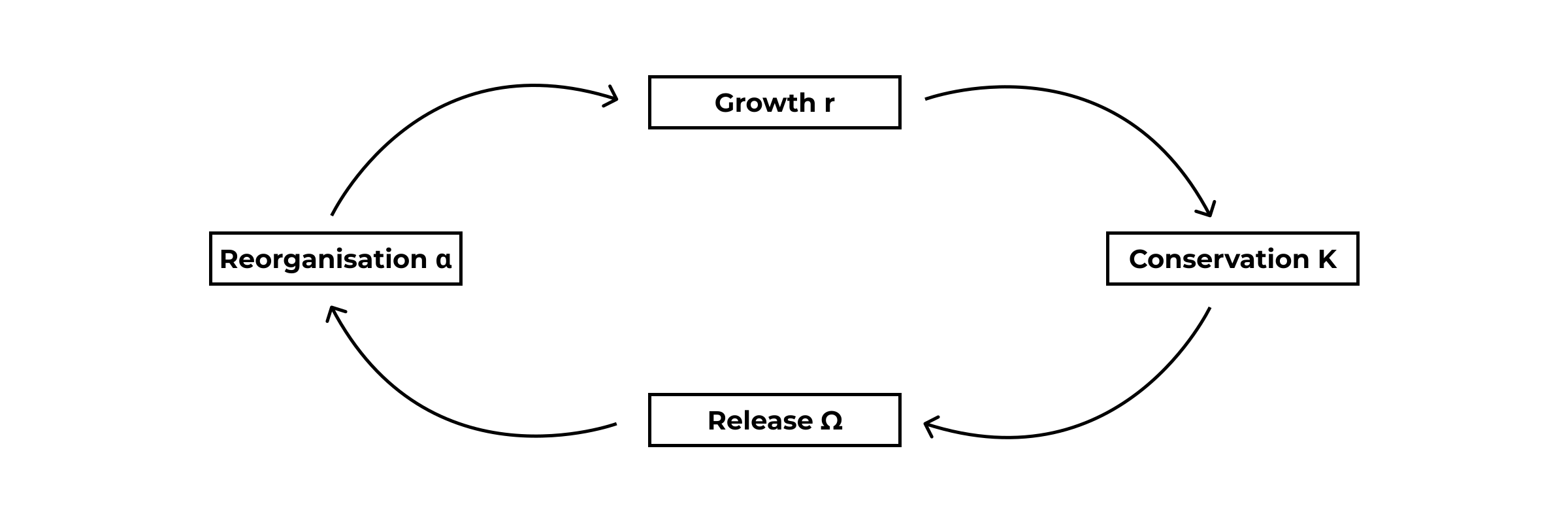
Growth — a phase of developing and accumulating resources, building structures. It is characterised by high adaptability and potential for change. Diversity offers protection; low internal rigidity enables rapid response.
Conservation — resources become increasingly connected, efficiency rises, specialisation grows, internal consolidation gets stronger, to the point where it becomes a weakness. The system becomes more rigid and less resilient, weaker response to external signals.
Release — a phase of rapid change or collapse, structures break apart, resources are released. Often triggered by a disturbance or crisis this is not a failure, but a necessary condition for renewal.
Reorganisation — the system reorganises and restructures, reaches a peak of creativity that is limited in time. High potential for innovation, new approaches emerge. Stabilising too early risks reproducing old patterns.
What might look like a random breakdown is actually the predictable result of a cyclical process. Tipping points announce themselves through early-warning signals, such as growing recovery times after disruptions, increasingly uniform decisions, or the concentration of dependencies. The model not only makes this dynamic observable but also indicates which measures work in which phase and which are counterproductive.
The model goes back to research by C. S. Holling and L. H. Gunderson (2002) and has since been extended to social, economic, and institutional contexts.
What this means in practice
Transformation projects based on FORMwelt methodology have shown savings in resources (time, communication energy and therefore costs) of up to 40 percent. Not because jobs are cut, but because unproductive loops, unnecessary coordination, and friction losses are clearly identified and resolved.
The model of adaptive system cycles adds a further dimension to this. It shows which phase an organisation is currently in and which will follow next. This allows goals to be fine-tuned over the medium and long term and measures to be adjusted specifically. What helps in the growth phase can harm in the maturity phase, and vice versa.
Both effects compound. Eliminating the superfluous means consuming fewer resources per outcome. Acting in line with the requirements of the development phase means effectively using resources. This is what makes a system regenerative using its resources in a sustainable manner and avoiding waste in any form that will later take its toll ecologically or economically.
What happens after the analysis
Before we offer any concrete measures, understanding the situation is key. Based on our thorough analysis we will determine adequate next steps:
Individual conseling
Coaching, sparring, and mentoring for executives and key individuals: creating broader options for action, preparing for new responsibilities or providing orientation in complex situations.
Conflict consulting
Mediation between individuals as well as structural conflict resolution in organisations: containing destructive potential, turning conflict into a productive force.
Team consulting
Workshops and training: deliberately shaping team dynamics, clarifying roles, transferring new skills into daily work.
Organisational consulting
Leadership and organisational development: aligning structure, aligning communication and decision-making capacity with purpose and strategy.
How our work helps
Suitable is our approach, for example, when
- transformations stall despite fancy methods used and budget allocated,
- the introduction of AI raises structural questions that traditional organisational development does not resolve,
- decision-making processes slow down as the organisation is growing,
- conflicts recur even though they have already been addressed multiple times, or
- growth, crisis, or restructuring phases require measures that actually fit the respective phase — not a best practice recipe.
Not suitable for companies seeking a standard solution without prior analysis.
Frequently asked questions
What distinguishes our way of working from traditional organisational development, agile, or New Work?
Other approaches operate at the surface level. We analyse the underlying formal layer: communication patterns that determine which change is possible and how, and the development phase that determines which measures can be used. No method is recommended before the analysis shows a clear fit.
We are not familiar with the methodological foundations. How established is the approach?
Both foundations are scientifically grounded and well-documented. They have both been used to analyse social systems. The combination is new offering a compound effect. Those start using it now have the chance to gain a knowledge advantage that will be difficult to catch up on.
How is effectiveness measured?
Effectiveness criteria are defined jointly at the outset. Every project is evaluated at completion according to criteria that fit the respective situation.
What does getting started cost?
Your investment will be clarified in our initial meeting. In principle, daily rates, fixed prices, and hour packages are possible; special terms are available during the initial proof of concept phase.
Precise analysis. Tailored measures. Guided with humanity.
Take the first step now.
Just schedule a meeting or write to us. We will start with an initial 45 minutes conversation: listening, asking questions, an honest assessment — without any sales pressure, and without you needing to know beforehand what or whether at all you are ready to order.